
- You are here:
-
Home

- Dyno data
Ultra-high speed data
In a unique dyno test series on Thumper Talk MXScandinavia dyno tested two shim stack configurations and obtained direct measurements of shim stack stiffness using a finger press.
A finger press inserts metal rods through the valve ports to directly measure shim stack stiffness. The MXScandinavia data shows the stiffness of the shim stack is nonlinear and the nonlinear behavior increases with stack lift. Nonlinear stiffness is one reason why shim factors perform poorly in scaling shim stacks.
Shim ReStackor analysis of the data shows the finger press shim stack stiffness and deflection measurements are consistent with the damping force measured on the dyno up to the dyno test limit of 120 in/sec.
The finger press data measured stack deflections well beyond that limit equivalent to hitting a four inch bump at 200 mph.
The finger press data verifies Shim ReStackor calculations of stack stiffness and gives confidence in applying the calculations at extreme conditions well beyond the limit of conventional dyno testing.

Finger press measures shim stack stiffness at high deflection and ultra-high suspension speeds
Faux crossover gap
A faux crossover gap never closes. Faux gaps are created by large crossover shim diameters, stiff low speed stacks or soft high speed stacks that do not produce enough force to close the crossover gap. MXScandinavia provides dyno test examples of faux crossovers.
In dyno testing, faux crossovers behave like a interactive crossover. Changes to the low or high speed stack changes the damping force leading many dyno tuners to believe the crossover gap is active.
However, the crossover gap height never changes as the shim stack deflects. The inactive faux crossover shim could be moved further up in the stack forming a simple tapered shim stack giving the same damping force and curve shape.
In dyno testing, there is no way to know the crossover gap is faux until the shock is pushed to high enough speed to observe the crossover closing. Soft closures of interactive crossovers make those events difficult to spot in damping force data.
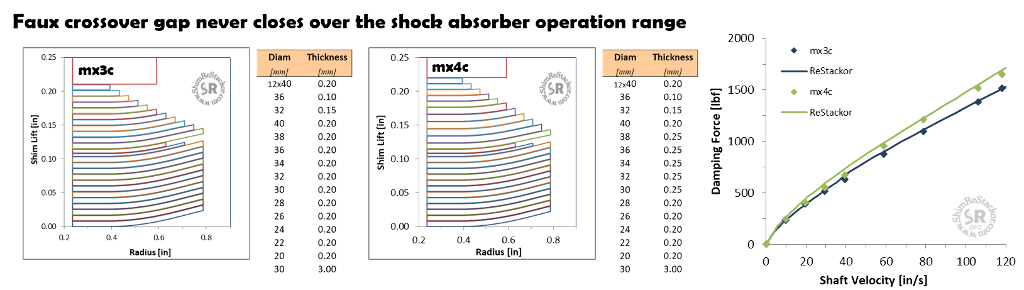
Faux crossover gap never closes creating confusion in operation of the shim stack
Trapped dirt, grit or lint
Dyno accuracy
Shim stacks are extremely sensitive to trace contaminants. A single particle from 800 grit sandpaper (0.025 mm diameter) trapped in the shim stack changes the damping force by 120 lbf.
Particles trapped inside of the shim stack clamp produce a crossover gap reducing the damping force. Particles trapped outside of the clamp preload the shim stack driving the damping force up creating a +/- 20% uncertainty in damping force.
For fielded shocks, any dirt, grit or lint trapped in the shim stack is ground up and spit out after a couple of hours of operation. Free of debris the shock returns to the nominal “clean stack” damping force.
Dyno tests, on the other hand, are only run for a couple of minutes. Trace contaminates, in the range of 800 grit sand paper, significantly alter the damping force measured. That creates problems comparing back-to-back tests with subtle differences in shim stack tuning and +/- 20% damping force noise.
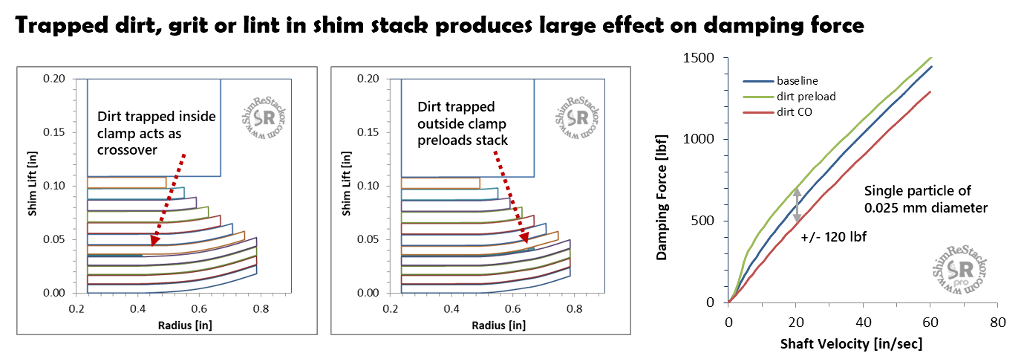
800 grit particle trapped in shim stack significantly changes measured damping force
Crossover tuning
Valving Logic demonstrated the effect of adding a crossover to a simple tapered shim stack. Adding the crossover makes the damping force softer everywhere, not just at low speed.
Tuning crossovers to produce the single effect of softer low speed damping requires multiple changes to the shim stack:
- The crossover position ...
- And diameter are adjusted to produce the desired low speed damping
- The crossover gap tuned to rpoduce the desired closure velocity
- The high speed stack reconfigured to produce the desired high speed damping
There is no algebraic equation to “design” a crossover. Crossovers are simply tuned by hacking around on each of the above four parameters to hit the target low and high speed damping force. Rapid calculations in Shim ReStackor make that easy.
Getting the crossover to work requires changing multiple parameters in the shim stack to obtain the single effect of softer low speed damping. Multiple simultaneous changes frustrates many tuners that only want to change “one thing at a time” when tuning a shim stack.
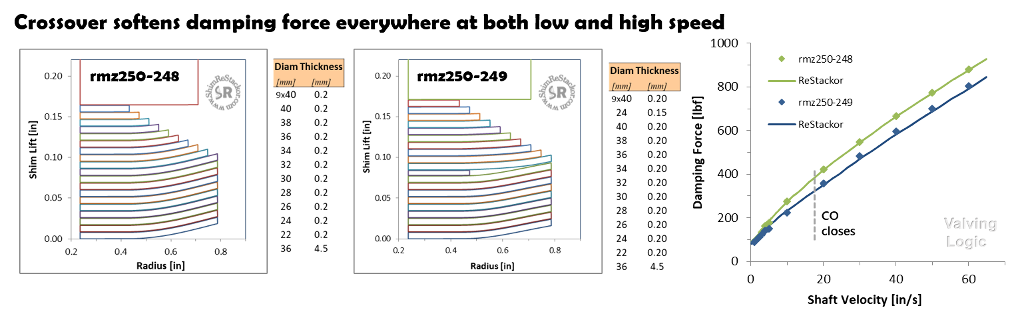
Controlling crossover low speed damping requires tuning the crossover position, diameter and high speed stack